


New Unmanned Delivery Technology | Practical Guide to Nationwide Low-Altitude Logistics Delivery Deployment
Annual express delivery volume in China has exceeded 199 billion parcels. Traditional last-mile delivery suffers from complex workflows, low efficiency and persistently high costs, accounting for over 50% of total logistics costs. Building a nationwide low-altitude logistics delivery network has become an inevitable trend. Grounded on standardized infrastructure and centered on the intelligent collaboration of "intelligent transfer cabinets + UAVs + unmanned vehicles", a full-coverage, highly interconnected low-altitude logistics delivery system is ushering the logistics industry into a new era of transformation and upgrading.
SkyGrid is a core force in the development of China’s nationwide low-altitude logistics delivery network. It possesses industry-exclusive intelligent low-altitude logistics delivery equipment, an intelligent management system and six internationally leading core technologies, delivering full-coverage low-altitude delivery solutions for multiple scenarios including rural areas, urban districts and industrial parks. The company has developed a Cloud-Edge-End integrated intelligent system, building a collaborative network of UAVs, unmanned vehicles and intelligent transfer cabinets: UAVs or unmanned vehicles undertake logistics transport; intelligent transfer cabinets serve as nodes for cargo exchange and storage; robots and robotic dogs complete transfer operations and the last 100-meter delivery. We continue to reshape logistics efficiency and the industry landscape, providing mature, reliable products and solid technical support for the construction of a nationwide low-altitude logistics network.
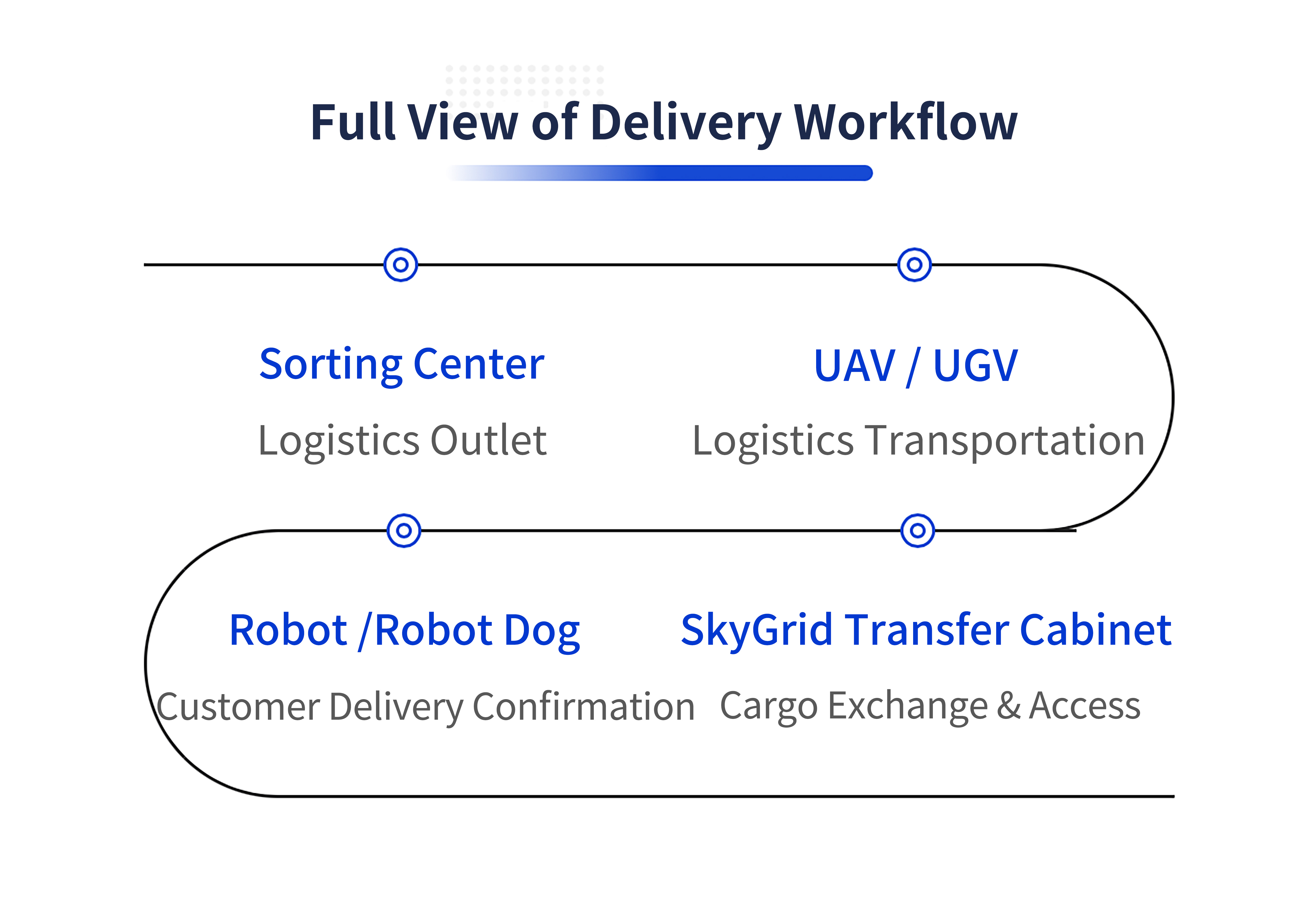
Full Workflow of Low-Altitude Logistics Delivery
Low-altitude logistics delivery is not simply "delivering goods via UAVs". Instead, it takes delivery stations as hubs, with UAVs and unmanned vehicles responsible for logistics transport, robots and robotic dogs completing transfer and the last 100-meter delivery, and transfer cabinets acting as logistics exchange nodes. The three work in synergy to form an all-weather, unmanned, full-coverage closed delivery loop.
Standardized Unmanned Logistics Delivery System
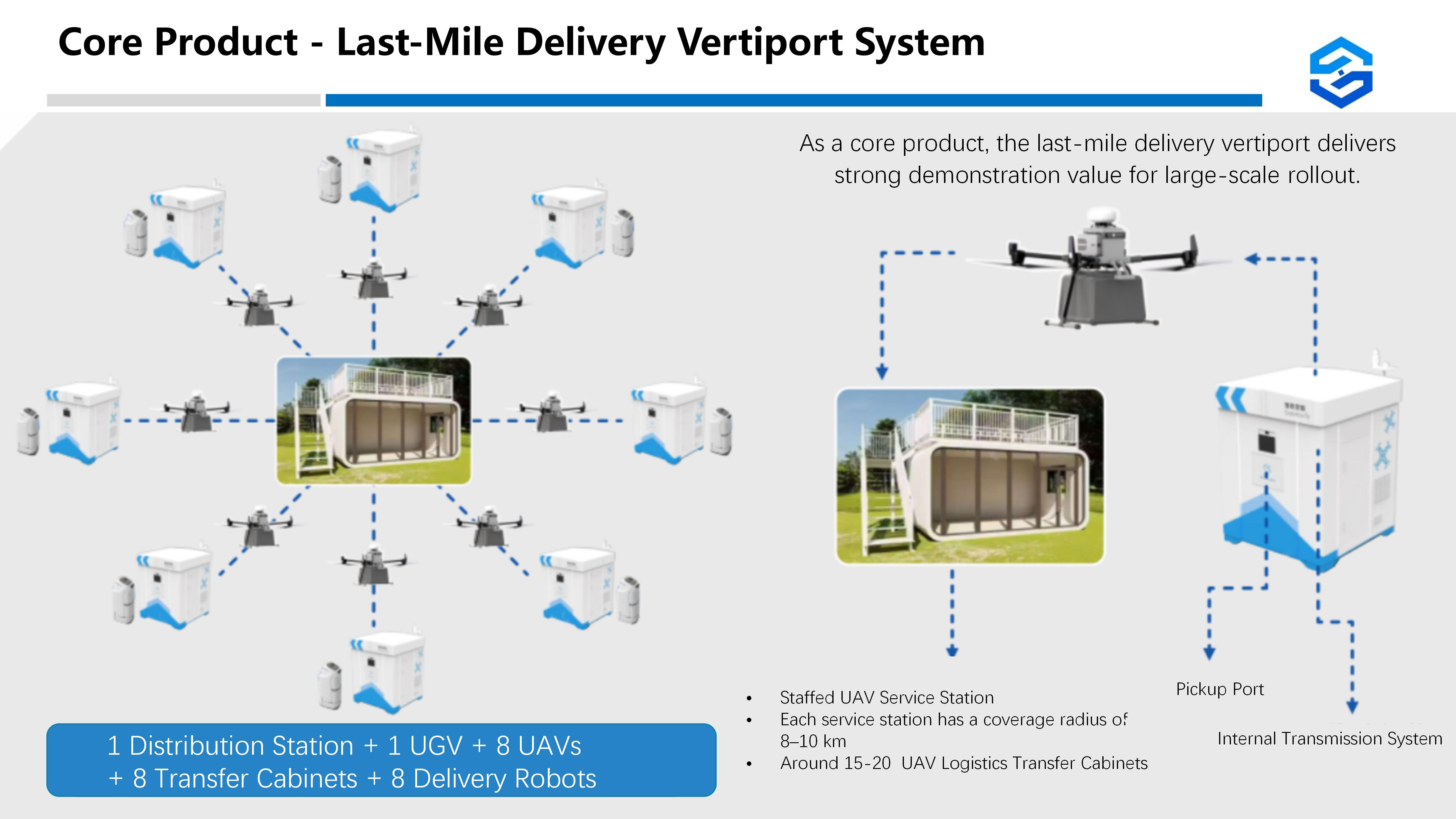
The construction of a nationwide low-altitude logistics delivery network should take standardized unmanned delivery systems as basic units to realize overall planning and large-scale implementation across the whole region.
SkyGrid’s standardized unmanned delivery system: 1 standardized unmanned delivery system = 1 delivery station + 1 UGV + 8 UAVs + 8 intelligent transfer cabinets + 8 robots / robotic dogs. A single system covers a radius of 4–5 kilometers, meeting the logistics needs of towns or rural areas.
Achieving Region-Wide Unmanned Logistics Delivery
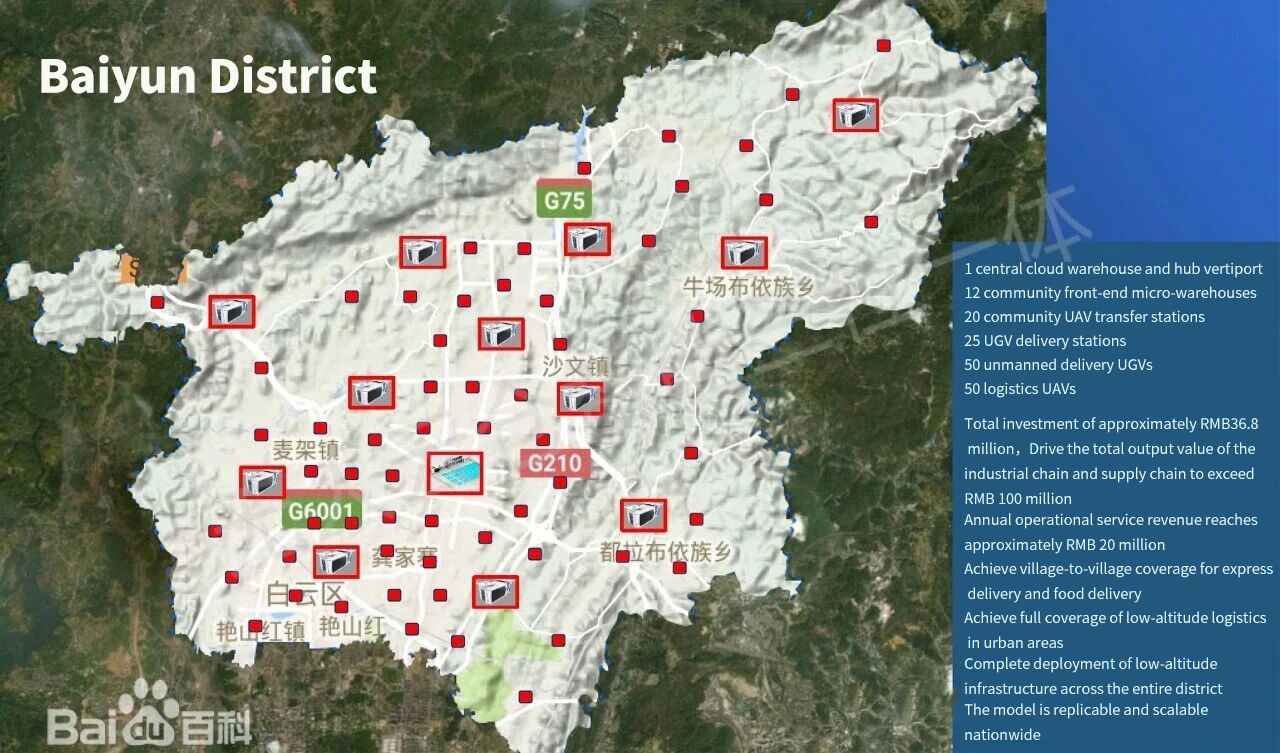
The standardized unmanned delivery system features high universality, strong adaptability and replicability: for mountainous areas, islands and suburbs with favorable airspace conditions, UAV delivery can be the core service; for core urban areas with strict airspace regulations, unmanned vehicle delivery can be prioritized.
Regions can adopt the approach of "tailored strategies for each city, customized solutions for each area" based on local geographical conditions, logistics demand and airspace policies. This model also effectively reduces R&D, manufacturing and operation & maintenance costs, laying a solid foundation for the large-scale nationwide promotion of low-altitude logistics delivery.
Investment and Return Calculation: Controllable Costs with Promising Returns
The core of achieving commercially sustainable development of low-altitude logistics networks lies in establishing a clear, quantifiable input-output model. Taking one standard unmanned delivery system as the accounting unit, and combining industry field test data, investment costs and operational returns can be calculated to provide strong support for decision-making.
- Investment estimation for unmanned delivery systems According to industry data, the total investment for one set of standardized unmanned delivery system is approximately RMB 2.3 million.
- Operational returns of unmanned delivery systems The standardized unmanned delivery system supports diversified businesses including express delivery, instant food delivery and medical supplies transport, with an average annual operating revenue of about RMB 1 million. The return on investment for express outlets rises from the traditional 10%–13% to 20%–25%. As scale effects drive down operating costs in the later stage, returns will grow steadily.
- Cost reduction, efficiency improvement and comprehensive value The standardized unmanned delivery system can reduce regional delivery costs by 30%–40% and double delivery efficiency. It also effectively reduces road delivery vehicles, practicing green and low-carbon development.
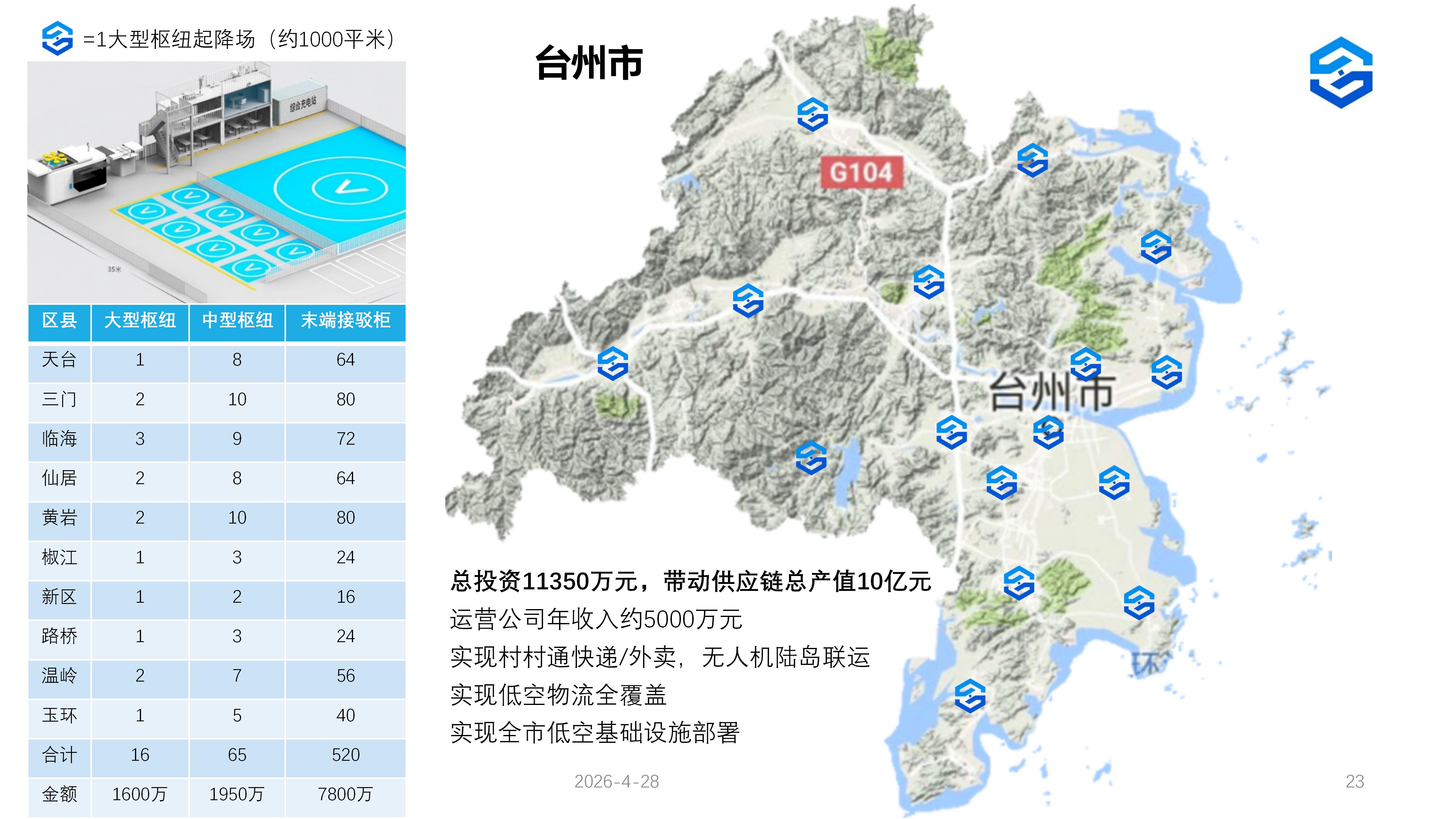
Taking Taizhou as an example, the network can drive an urban supply chain output value of approximately RMB 1 billion, with an annual revenue of about RMB 50 million for operating companies. It will realize universal express and food delivery to every village, UAV land-island intermodal transport, and full-region low-altitude logistics coverage. The establishment of urban low-altitude infrastructure will deliver both economic and social value.
Nationwide Deployment Strategy: From Pilot Projects to National Coverage
The nationwide layout of low-altitude logistics delivery should take the unmanned delivery system as the core, build a "hub – node – last-mile" three-tier infrastructure system, and advance in phases and regions under the principles of national overall planning and regional coordination. This will realize steady implementation from pilot demonstration to full-region coverage, and from single-point operation to large-scale replication.
Pilot Demonstration: Building Regional Benchmarks
Regions shall prioritize pilot programs in areas with urgent logistics demand, build unmanned delivery systems and demonstration routes, and launch key scenarios such as express delivery, food delivery and healthcare. This will verify the "intelligent transfer cabinets + UAVs + UGVs" model, create replicable benchmarks, and formulate standardized urban deployment manuals.
Full-Region Rollout: Large-Scale Station Construction
After successful pilots, scale up the deployment of unmanned delivery systems at municipal and provincial levels based on population density, logistics demand and geographical conditions to achieve full-region coverage. Meanwhile, improve supporting facilities at hub nodes, connect air-land transfer networks, and build an integrated three-dimensional low-altitude logistics delivery system.
Cross-Province Collaboration: Forming a National Network
Based on provincial low-altitude logistics networks, open cross-provincial air routes to realize interconnection of national-level hubs. Promote the normalization of cross-regional UAV delivery, build a nationwide integrated low-altitude logistics delivery system, and achieve the inclusive goal of "universal express delivery to every village, logistics access to every island, and instant delivery in urban areas".
Building a nationwide low-altitude logistics network requires overall government planning, strengthened policy support, integrated resource elements, and coordinated advancement guided by social capital, technology and operating enterprises. It should be incorporated into key new-type infrastructure and low-altitude economy projects, with special task forces established to coordinate airspace, site and funding support, simplify UAV flight approval, designate regular flight routes, and improve dynamic airspace management. We shall coordinate site resources in urban, rural and island areas, improve supporting facilities such as base stations and takeoff and landing sites, open up multi-field application scenarios, and build a sustainable commercial closed loop.
The low-altitude logistics network is a key driver for reducing logistics costs and improving efficiency, advancing rural revitalization, and developing the low-altitude economy. With the core model of "intelligent transfer cabinets + UAVs + UGVs", supported by standardized unmanned delivery systems, and through government coordination, technological empowerment and market participation, we will accelerate the construction of a nationwide integrated low-altitude logistics network, inject new momentum into high-quality development, and make the low-altitude economy an important pillar of new quality productive forces.